

What Does 30 Grams of Fiber Look Like? 6 Foods + Meal Ideas

A bowl of creamy oats, a loaded sweet potato and something crunchy to snack on. Getting more fiber can look a lot more appetizing than a spoonful of bran.
If you have ever wondered what 30 grams of fiber actually looks like, this visual guide makes it practical. Six everyday plant foods can get you close, and you can spread them across meals you already enjoy.
What does 30 grams of fiber look like? One example is ½ cup dry rolled oats, 1 tablespoon chia seeds, 1 green kiwi, 150 g avocado flesh, 1 cup cooked sweet potato and a small handful of shelled pistachios. Using the measured portions below, that adds up to about 30 g of fiber.
Think of these as ingredients for your day, rather than a plate to finish in one sitting. They are a fiber foundation, with room for the protein foods, vegetables and other ingredients that make meals satisfying.
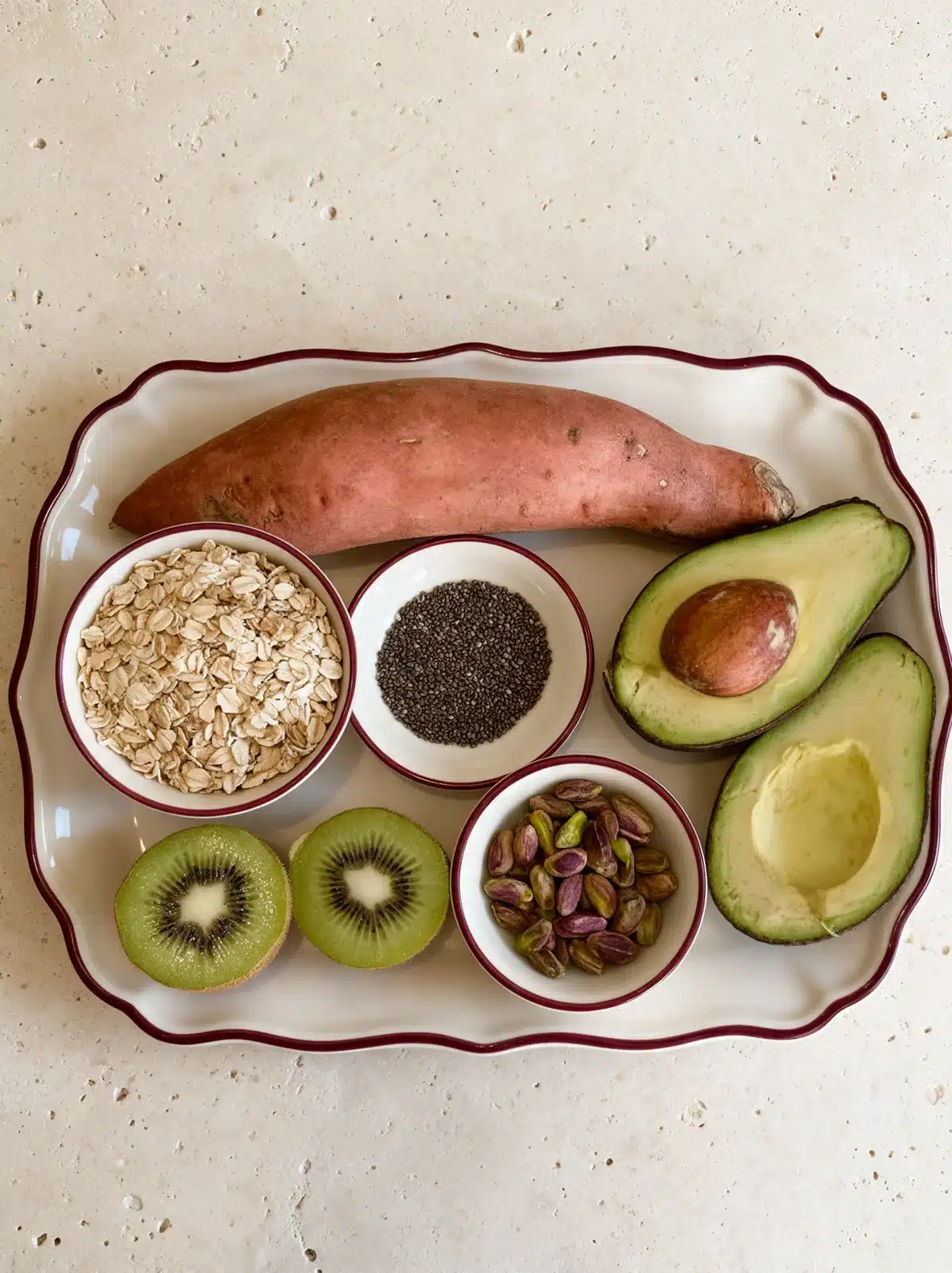
6 foods that add up to about 30 grams of fiber
The portions here provide roughly 29.6 g altogether. Food size and brands vary, so use this as a useful guide rather than a number you need to hit perfectly. “Fiber” and “fibre” mean the same thing.
1. Rolled oats
½ cup dry oats (40 g) · About 4 g fiber
Oats make an easy starting point because they fit into a breakfast you can prepare in minutes. Cook them into porridge, leave them to soften overnight, or use them in a savory bowl with mushrooms and tofu.
Measure this portion before cooking. Dry oats absorb liquid and become a much bigger bowl. A cup of dry oats and a cup of cooked oatmeal are different portions, so their fiber numbers are not interchangeable. The amount here uses plain rolled oats.
Make it delicious: Cook with fortified soy milk, add cinnamon and finish with sliced kiwi. Stir in extra liquid if you prefer a softer bowl.
2. Chia seeds
1 tablespoon · About 4.1 g fiber
A spoonful of chia adds fiber without needing another dish. It thickens oats and puddings as it absorbs liquid, giving them a soft, spoonable texture.
Mix it thoroughly into your oats or another moist food, then let it hydrate. If chia is new to you, start with a smaller amount and build up as comfortable. You can use black or white chia.
Make it delicious: Stir chia into overnight oats with soy milk and vanilla. Give the mixture another stir before refrigerating so the seeds do not clump.
3. Green kiwi
1 kiwi with about 75 g edible flesh · About 2.3 g fiber
Kiwi brings a bright, tangy contrast to creamy oats. Cut it in half and scoop it with a spoon, or peel and slice it over breakfast.
This estimate is based on the edible fruit, so there is no need to eat the skin to make the example work. The figure is calculated from USDA green kiwi data; a smaller fruit will contribute a little less.
Make it delicious: Add kiwi just before serving your oats so its fresh texture stands out against the creamy base.
4. Avocado
150 g avocado flesh · About 10 g fiber
Avocado is useful when you want creaminess as well as fiber. Mash it onto toast, slice it into a bowl or turn it into a quick sauce with lemon and herbs.
Use the flesh weight, without the skin or stone. Whole avocados vary considerably in size, and you can divide this amount between lunch and dinner. The estimate uses USDA avocado data.
Make it delicious: Add half your avocado to my Creamy Asian Cucumber Salad, which also includes tofu and edamame. Save the rest for your sweet potato later.
5. Sweet potato
1 cup cooked sweet potato · About 6.3 g fiber
A roasted sweet potato gives you a soft, sweet base for something savory. Chickpeas, smoky spices, tahini and lemon all work beautifully with it.
For this example, measure the cooked portion. A whole sweet potato can be tiny or enormous, so “one sweet potato” alone does not tell you how much fiber it contains. The USDA-based food table gives the amount for a cooked cup.
Make it delicious: Try my Loaded Baked Sweet Potatoes with chickpeas, spinach and tahini dressing. Add your remaining avocado for a creamy finish.
6. Pistachios
A small handful of shelled nuts (28 g / 1 oz) · About 2.9 g fiber
Pistachios bring the crunch. Keep a portion ready for a snack, roughly chop them over breakfast, or scatter them across a warm vegetable dish just before serving.
The portion refers to the nuts you eat, without their shells. If you buy them in-shell, shell them before weighing this example amount.
Make it delicious: Chop pistachios with parsley and a little lemon zest, then sprinkle over your loaded sweet potato. It makes a simple dinner feel special.
From ingredients to meals
How to get 30 grams of fiber across the day
Here is one relaxed way to use the six foods. The fiber contributions refer only to those measured ingredients; the other foods you add will contribute more.
Breakfast: kiwi & chia oats
Cook the ½ cup dry oats with soy milk, or prepare them overnight. Mix in the tablespoon of chia and top with the kiwi.
About 10 g fiber from the oats, chia and kiwi.
Lunch: a crunchy bowl with avocado
Use 75 g avocado in a tofu bowl or my Creamy Asian Cucumber Salad. Add rice or bread to suit your appetite.
About 5 g fiber from the avocado, plus the rest of your lunch.
Dinner: loaded sweet potato
Enjoy the cup of cooked sweet potato with your remaining 75 g avocado. Chickpeas, greens and a spoonful of tahini dressing make it a proper meal.
About 11 g fiber from the sweet potato and avocado.
Snack or topping: pistachios
Enjoy the small handful on its own or split it between breakfast and dinner for extra crunch.
About 3 g fiber from the pistachios.
You do not have to eat all six every day. If your usual meals already include beans, whole grains, fruit and vegetables, you may reach your target with smaller portions or fewer additions.

Easy swaps if these are not your favorite foods
Variety makes this easier to keep doing. You can swap the foods for other fiber sources without trying to recreate the platter exactly.
- Prefer beans to avocado? Use chickpeas or lentils in a lunch bowl, soup or sandwich. Try my Crispy Lentil Veggie Patties Sandwich.
- Not a kiwi fan? Add berries, pear or another fruit you enjoy to breakfast.
- Need a nut-free option? Use seeds you tolerate or add beans to a meal instead of the pistachios.
- Prefer a savory breakfast? Have wholegrain toast with avocado and tofu, then use oats another day.
Different portions supply different amounts of fiber. The goal is an enjoyable routine, so choose foods you like rather than forcing a precise one-for-one swap.
Why aim for 30 grams of fiber a day?
30 g is a useful adult benchmark because it turns a broad recommendation to eat more fiber into something you can picture. It is the UK’s recommended daily intake for adults, and it sits close to the intake range linked with health benefits in major research.
Recommendations differ slightly. The World Health Organization recommends at least 25 g of naturally occurring fiber daily for adults. In the US, NIDDK gives a range of 22–34 g, depending on age and sex. So 30 g is a practical guide, not an exact requirement for everyone.
The useful habit is spreading whole grains, pulses, fruit, vegetables, nuts and seeds through your day. You do not need to hit precisely 30.0 g, and a gradual increase from your usual intake is a better starting point than chasing a perfect total.
What does the research say about fiber?
Higher-fiber diets and long-term health
A major 2019 review in The Lancet brought together 185 prospective studies and 58 clinical trials. The clearest risk reductions across several outcomes appeared around 25–29 g a day, with possible benefits at higher intakes too.
Observational studies linked higher fiber intake with lower rates of conditions including heart disease, type 2 diabetes and colorectal cancer. Trials also found improvements in measures such as total cholesterol and systolic blood pressure. This supports a fiber-rich eating pattern; it does not mean this exact platter prevents disease.
A simple daily goal can be practical
In a 12-month randomized trial of 240 adults with metabolic syndrome, one group was encouraged to get at least 30 g of fiber daily; the other followed a broader American Heart Association diet. Both groups received dietary support and lost a modest amount of weight.
The fiber-focused approach was not superior, and setting a 30 g goal did not mean everyone reached it. Its practical lesson is that one clear food habit can be a manageable place to start, rather than changing everything at once.
Fiber can help bowel regularity, but build up gently
A 2022 review of 16 randomized trials found that fiber supplements improved stool frequency and consistency in adults with chronic constipation. Results varied by fiber type, and gas could increase.
Those trials tested supplements, rather than this six-food combination. For everyday eating, the useful takeaway is to increase fiber gradually, drink enough fluids and pay attention to how your gut responds.
How to increase fiber without making yourself miserable
Jumping straight from a low-fiber diet to a much higher intake can leave you bloated or gassy. Give your gut time to adjust.
- Start with one change. Try oats at breakfast or add a little lentil to lunch. Keep it comfortable before adding more.
- Spread it out. Breakfast, lunch, dinner and snacks give you several opportunities. You do not need to squeeze the whole day into one meal.
- Drink regularly. Water and other fluids help fiber do its job. Your fluid needs depend on your health, activity and environment.
- Listen to your digestion. If symptoms worsen, reduce the increase and reassess instead of forcing a target.
These steps follow NIDDK advice to increase fiber gradually and get enough fluids. If you have been prescribed a low-fiber diet or have persistent digestive symptoms, get individual advice before making a large change. For more food ideas, see my guide to foods for constipation.
Frequently asked questions
What is the easiest way to eat 30 grams of fiber a day?
Include a fiber source at each meal, then use fruit, nuts or seeds for snacks and toppings. Oats with chia and kiwi, avocado in a lunch bowl, and sweet potato at dinner are one practical combination. Your other meal ingredients count too.
Is 30 grams of fiber enough each day?
It meets the UK adult recommendation and is above the WHO’s adult minimum of 25 g. US recommendations vary by age and sex, with some adults advised to get more. Use your own needs and usual eating pattern as the guide rather than treating 30 g as a universal target.
Can I get 30 grams of fiber without supplements?
Yes. Whole grains, beans, lentils, fruit, vegetables, nuts and seeds can provide that amount through food. The six measured portions in this guide contribute about 30 g on their own.
Do I need to weigh everything?
No. Measuring a few portions once can help you recognize what they look like. After that, familiar serving sizes and the occasional check of a food label can be enough for everyday planning.
Is 30 grams of fiber in one meal too much?
It can be uncomfortable, especially if you usually eat little fiber. Spreading your intake over the day is often easier to tolerate. This guide is a day’s ingredient example, not a recommendation to eat everything at once.
Does cooking oats remove their fiber?
Cooking plain oats with water changes their volume and texture, so a cooked cup contains a different amount of oats from a dry cup. Measure the oats dry for this example and count any milk or toppings separately.
Does a vegan diet automatically provide enough fiber?
No. The amount depends on the foods you choose. A day built around refined grains and low-fiber convenience foods can still fall short, while meals with pulses, whole grains, vegetables and fruit make it easier to get enough.
Research sources & portion calculations
The total uses 4 g from 40 g rolled oats, 4.1 g from chia, 2.25 g from 75 g green kiwi, 10.05 g from 150 g avocado, 6.3 g from cooked sweet potato and 2.9 g from pistachios. The sum is 29.6 g; individual values above are rounded for readability.
- Dietary Guidelines: Food Sources of Dietary Fiber. USDA-based serving values for cooked sweet potato, chia seeds and pistachios.
- USDA FoodData Central: raw avocado, all commercial varieties and raw green kiwifruit.
- Quaker Old Fashioned Oats. Example rolled-oat portion; check your own package.
- NHS: How to get more fibre into your diet.
- NIDDK: Eating, Diet, & Nutrition for Constipation.
- WHO (2023): Carbohydrate intake for adults and children.
- Reynolds et al. (2019): Carbohydrate quality and human health, The Lancet. Systematic reviews and meta-analyses.
- Ma et al. (2015): Single-component versus multicomponent dietary goals for the metabolic syndrome, Annals of Internal Medicine. Randomized trial.
- van der Schoot et al. (2022): The effect of fiber supplementation on chronic constipation in adults, The American Journal of Clinical Nutrition. Systematic review and meta-analysis.